
 Campaign by
Story
A bad bike smash led to Martin Mooney discovering a condition which had held him back all his life.
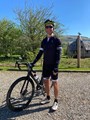
And now, fully recovered from his injuries and safely back in the saddle, Martin is undertaking a massive challenge to raise money for Spina Bifida Hydrocephalus Scotland.
“Living and Riding : 60 for Hydrocephalus”
will see Martin undertake 60 gruelling 60k bike rides between now and November to raise awareness of the charity as well as much needed funds.
You can follow all of Marty's 60 ride here:
https://www.sbhscotland.org.uk/60-for-60/
Martin was 36 when he discovered he has hydrocephalus which doctors believe he has had since birth.
With this diagnosis, all the struggles he’d experienced in his life, made sense.
Martin, 44, said: “I am a very keen road cyclist but I had a bad accident in June 2017 when I came off my bike.
“I am always very good at texting my dad when I stop for my coffee stops in Aberfoyle or wherever.
“Dad hadn’t heard from me in a while and knew something wasn’t right so he drove the route I had cycled and he found me at the side of the road. I had come off my bike and was unconscious.”
Martin was taken to the Queen Elizabeth University Hospital with a broken collar bone, broken ribs and a broken pelvis. But he also had a head injury so he had an MRI which showed excess fluid .
He was transferred to neurosurgery where a probe was inserted in his head to record fluid pressure.
Martin said: “It turned out I had non-pressurised hydrocephalus since birth.”
The medical team has since helped him to understand both his condition and the symptoms which have affected him for as long as he can remember.
He said: “It took a wee while to process my condition but eventually I realised that my life experiences and mental health were as a result of NPH so as bad as the crash was, good came of it, because it answered so many questions I had always asked of myself.
“It is the equivalent of constantly walking with broken legs when you and everyone else, doesn’t know they are broken.
“But I now know I have a reason for being the way I am and always have been.”
Martin continued: “I had asked myself questions because I always knew something wasn’t right. I come from quite an academic family; my dad was a chemistry teacher and my big brother did really well at school.
“I studied really hard but always came up short. I struggled to process information and recall it for exams. This became demoralising, stressful and mentally depressing.
“ after leaving school, my limited processing skills had a big impact on my employment. It became very stressful for me because employers were not always supportive.
“Over a few years it was obvious I needed support since my condition, unknown to me at that point, increasingly presented as anxiety, irritability, forgetfulness, depression and I even became less steady and sure on my feet.
Eventually, in May 2012 this presented as a breakdown.
His psychologist discovered that the best antidepressant ‘drug’ for Martin was actually exercise.
He took up running and got himself a dog to increase his fitness.
But he said: “After running like Forest Gump for a year or two I developed cartilage problems in my knees which negatively impacted my running. He explored alternative forms of exercising including road cycling - encouraged by his dad who is a keen road cyclist - and found a real passion for the sport.
“Cycling was by far the best medicine for my issues. Getting out, flying along the road in the sun with the countryside around you is a fantastic feeling.
He said: “I also work with Bike for Good. It is a social enterprise which has a couple of outlets in Scotland. I volunteer in there on a Tuesday and a Thursday. We take in bikes from the public, recondition them and put them back out to the public.
“I work in the service area and if we can’t fix them we strip them down for parts. We also actively support the local community through cycling with group rides and learning to ride. Bike for Good is now an integral part of my life.”
Recently Martin had a recurrence of his old knee problem and faced the prospect of never riding again after an MRI scan revealed severe arthritis in his knee joint because of the lack of cartilage.
He explained: “I was too young for a knee joint replacement because I would wear it out too soon.”
However, by chance his consultant had learned of someone pioneering robotic, partial knee replacement surgery.
It was a similar surgery to that which saved American skier Lindsey Vonn’s career and enabled her to become the oldest women to win the World Cup in 2025 at 41 and compete in this year’s Winter Olympics.
The surgery Martin had involved a CAT scan to highlight the arthritic bone on the side of the knee before a robotic drill removed the highlighted bone to the proper depth, whereupon a previously prepared metal plate of exactly the size of the removed bone was inserted before plastic cartilage was placed between the bone.
Martin said: “That procedure saved Lindsey’s career and it’s now saved mine.”
And now he is putting those special skills to good use by getting on his bike to cycle 60x 60k rides in honour of Spina Bifida Hydrocephalus Scotland’s 60th birthday last year.
He said: “If cycling helps me live with hydrocephalus - then why don’t I ride for hydrocephalus.”
“ It just makes sense to me “
“ Living and Riding : 60 for Hydrocephalus “