

Story
Alzheimer’s has a profound impact not just on the person unfortunate enough to be diagnosed with the condition but also on their immediate family. It has touched my family as my daughter, Isla, explains below.
“When I was eighteen, my mum Sue began to show symptoms of memory loss, struggling with her job as a library assistant. Only in her late fifties at the time, she believed she was beginning to develop dementia - however because of her relatively young age, she was told it was more likely to be a result of depression or anxiety, and passed the diagnostic tests for dementia with no issues. She was prescribed a common medication that doubles as an antidepressant and anti-anxiety treatment and improved hugely. I was able to leave for university that autumn thinking the problem was solved, and without worrying she would struggle to cope on her own.
Sadly, three years later, she was proven correct - it had simply been too early in the progression of the disease for the tests to catch it. During my third year of university, she was formally diagnosed at the age of sixty, making her a case of ‘young onset dementia’. I arranged with the university to retake my third year, and went home early. My older brother and I spent that summer bouncing from pillar to post trying to set up a system where Mum could continue to live at home alone while I returned south for one more year to finish my degree.
Ultimately this proved impossible. Because Mum was younger than the typical age of onset, she constantly fell through the cracks, being discharged back into the care of her GP when she should still have been with the specialist, then re-referred, then discharged again. Instead of studying for my exams or writing my dissertation, I was 200 miles away spending hours every day being flung around the NHS switchboards like a pinball, trying to figure out who was meant to be doing what and making sure they did it, then calling Mum at the end of the day to check she was eating and managing alright. In the end, my uni work fell by the wayside and I was unable to complete my degree - luckily, I had the option of transferring to the Open University and studying part-time. I moved home, took a job as a cleaner in the local pub four mornings a week, and became Mum’s full-time carer while studying part-time. In 2019, I graduated from the OU with a 2:1 Open Honours BSc, and I will forever be incredibly grateful and proud to be an alumnus of the OU - without them, their flexibility, understanding, and support for carers, I would not have graduated.
Mum’s diagnosis of ‘atypical’ dementia, combined with her relatively young age, threw us into the deep end. The early days of juggling her retirement on grounds of ill health, applications for pensions and disability benefits, council tax reductions, doctor appointments and checkups, along with the emotional upheaval of such a diagnosis, was like a wrecking ball. All our expectations of what the future looked like were in pieces, and we had no idea how to navigate - when I look back now, I’ve no idea how we coped. We’re lucky to have a tight-knit, loving family, and many friends, but the professional help we needed was in many ways, absent - and has continued to be. A diagnosis of dementia is always going to be devastating, both to the person receiving it and the people who love them, and as it stands, the centralised support needed can charitably be described as ‘patchy’, on all fronts - medical, social, practical.
To be a non-professional carer for someone with dementia is to be possibly the most deeply underqualified you will ever be in your life. I haven’t been trained for this, I am not a nurse or care assistant sent away on courses or to shadow experienced staff on their rounds. You’re tossed headfirst into a deep dark sea and told to swim - only you’re using Google to teach yourself to doggy-paddle as you go, and all you ever manage to do is keep your head just above the water for most of the time. There’s no time or energy to spare for searching for a better way. Eight years into this I still encounter snippets of information that would have been desperately helpful at the outset, usually when I’m searching for something entirely unrelated. Just last year, out of the blue, I discovered that it is not uncommon for people with the variant of dementia Mum is believed to have aspects of, to end up legally blind.
I should not, eight years on, be discovering these things while sitting alone at my desk, wading through the wilds of the internet in search of support.
A 2015 report by Alzheimer's Research UK found that 1 in 3 people born that year will go on to develop dementia at some point in their lives. Current science states that there is no concrete genetic component to the kind of dementia Mum has - but I can’t deny that I am conscious, at two years off my thirtieth birthday, that in another thirty years I will be the same age as she was at diagnosis. Dementia has been a daily presence for me more or less since I became an adult; will it bookend my life? And if, thirty years from now, I am sat across from my doctor as they tell me I too have developed this condition - will I recognise the tests, the medication that helps for a while, but doesn’t cure, the prognosis that there is no light at the end of this tunnel? Will absolutely nothing have changed? Will the systems of care still be crumbling under the increasing weight they’re expected to carry without proper funding or support, while loved ones burn themselves out trying to plug the gaps?
This is not a problem that is going away.
Mum is now about eight years post-diagnosis, and more than a decade past her first symptoms appearing. Her condition has deteriorated, but we always find something to laugh about over the course of a day. Currently she is staying at a care home while I enter another round of wrangling care systems in order to adapt our house to her increasing needs, in the hope I will be able to bring her home to her familiar garden, her cats and her photographs.
Being a carer for a loved one with a progressive, degenerative disease, is to find yourself grieving while they’re still standing there in front of you. It’s a peculiar, piecemeal sort of grief, but it is interspersed with moments of real joy. You learn to look for those moments in the smallest things.
I hope that thirty years from now, I will be able to look at the world around me and not see people searching desperately for those moments of joy as dementia lays waste to their lives. I hope that with time and funding, research will have moved on in leaps and bounds. Medicine, like any science, is incremental in its progress, work building upon work - but if the history of human medical achievement teaches us anything, it’s that with time, and support, and the will to keep making that incremental progress, we can improve any prognosis, even as we never stop searching for a cure”.
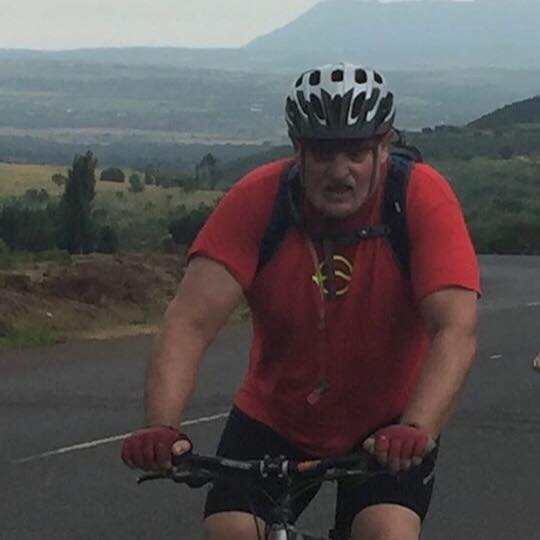
This is why I am digging out my walking boots and, in my 70th year, challenging myself to raise at least £700 by climbing Kilimanjaro in September.
Having read Isla’s story I hope that you will consider sponsoring my challenge. All funds raised will go directly to the Alzheimer’s Society which aims to support families confronted with this cruel disease.