

Story
For Grandad & Grandma
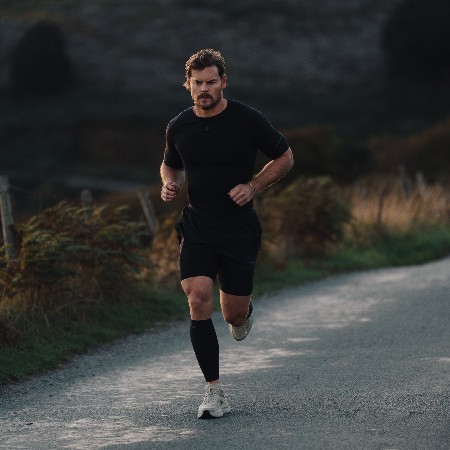
On 1st November, I'll stand on the start line of the New York City Marathon. 42.2 kilometres. Five boroughs. Thousands of runners. But every step will be for two people who shaped my childhood.
My Grandad, Tom Rees. And my Grandma, Christine Libbey.
I'm running because Alzheimer's has already taken one of them from us, and is now taking the other.
This isn't just about raising money. It's about honouring two remarkable lives, while helping create a future where fewer families have to experience what ours has.
My grandad's story (my mum's dad)
He grew up in a small Welsh village, one of twins, before joining the Royal Marines, where he rose to Sergeant and became a Physical Training Instructor. He rode a white horse called Pegasus.
As a modern pentathlete, he was selected to represent Great Britain. But in those days the Olympic team was dominated by officers, and Grandad was a sergeant. He missed out on the 1956 Games, probably more down to rank than ability, and that dream was never realised.
In the late 1960s, he was posted to the Middle East as a Royal Marines training instructor. When his team was pinned down by enemy fire, he took charge and single-handedly neutralised the enemy position. He was awarded the Military Medal for it, one of the highest honours there is for bravery in the face of the enemy.
He was just Grandad to me. A vision. Someone I wanted to follow. For years I was convinced I was going to join the Royal Marines and aim to be a PTI, just like him.
He was the man I'd wrestle with on the living room floor. The man I'd watch rugby beside, as he drank his ale from the same handled pint mug. He was an incredibly talented artist, especially when it came to painting horses.
My grandma Peggy, his wife, passed away from lung cancer shortly after I was born. I don't have any memory of her, only photographs.
Years later, Grandad's health went into a rapid decline. His world became smaller, and the dementia arrived quickly. The confusion. The frustration. The moments where he no longer understood the people trying to help him.
The man who had spent his life training others to be physically strong was gradually trapped inside a body and mind that no longer worked together.
In the end, Alzheimer's took even the automatic functions we never think about. His brain could no longer communicate with the muscles responsible for swallowing, and we lost him. I was 16.
Watching someone so full of life decline like that traumatised me.
Watching my mum lose her dad, after already losing her own mum, broke my heart.
When I run through New York, I'll be carrying Grandad with me.
On my race vest will be three Welsh feathers, honouring his roots and the country he loved. Alongside them will be Pegasus, the white horse that represented adventure, courage and a life that refused to stand still.
They're small illustrations. But they tell the story of a remarkable man.
My Grandma's story (my dad's mum)
My Grandma Christine shaped my life in quieter ways.
She spent her entire career as a school teacher. For a short while, she was even mine. She was endlessly curious. She devoured books, dozens in a single week. Learning wasn't just something she enjoyed; it was part of who she was. She had an incredible mind, and she encouraged that same curiosity in everyone around her.
Whenever I hear the squawk of a seagull, I'm instantly transported back to being a little boy at her house.
It's funny how memory works. Sometimes a single sound can carry you back decades. Smells can do the same thing for me.
After my grandad, her husband, died, something changed. Her world slowly became smaller. Dementia didn't snatch her away, just gentle knocks at the door. But those knocks became more frequent, louder, harder, and eventually dementia had arrived.
Today, she is in the most advanced stages of the disease.
The truth is, she no longer knows who any of us are. The memories have all gone. The woman who once filled her mind with stories can no longer recognise the people who helped write her own.
As difficult as it is to say, I suspect we are approaching the end of her journey. There is a sadness in that, but also a quiet acceptance. Watching someone you love live in the final stages of Alzheimer's is heartbreaking, not only because you fear losing them, but because, in so many ways, you've already had to begin saying goodbye.
When I run New York, there will be a seagull on my race vest. Not because of the bird itself, but because of what it represents.
Home. Childhood. Summer afternoons. The sound that instantly brings my grandma back to me.
Two stories. One family. One race.
My own fears.
There's something else I want to be honest about.
Watching this disease take two people I love has planted a seed of fear in me. A quiet question I carry around: will it come for me too?
I'd be lying if I said it doesn't shape me. It's a big part of why I live the way I live. Why I train. Why I look after my body. Why I try to keep my mind clear and not let it get muddled.
But I don't want to just sit with that fear. I want to do something with it.
That starts with taking care of my own health. And it means fighting this disease however I can. This race is me doing both.
Why I'm running
Alzheimer's doesn't only affect the person diagnosed. It changes entire families. It steals conversations before it steals lives. It slowly erases the people who helped make us who we are.
I'm running for my grandad and my grandma.
I'm running for my mum and dad.
And I'm running for every family who knows the heartbreak of watching someone they love slowly disappear.
If you'd like to support my journey, every donation, large or small, will help the Alzheimer's Society continue its vital work supporting families like mine and funding research that brings us closer to better treatments, and one day, a cure.
Thank you so much for your support,
Ryan xx